
EMDR Therapy for Grief: Processing What Time Alone Can't Heal
You've heard it a hundred times: time heals all wounds. And maybe you've been waiting. Waiting for the weight of it to lift. Waiting to feel like yourself again, or at least like a version of yourself who can get through a Tuesday without being floored by grief.
But months have passed. Maybe longer. And the pain of loss still shows up uninvited: during a song you weren't expecting, in the cereal aisle, at 2 a.m. when everything gets too quiet.
Grief is a natural response to loss. But that doesn't mean you're supposed to carry this alone, indefinitely, without any real support for what's happening in your nervous system. EMDR therapy for grief offers a different path. Not one that asks you to "move on" or stop loving who you lost. One that helps your brain actually process what's gotten stuck, so you can carry your grief with more peace and less weight.
In this article, we'll cover:
When Grief Doesn't Go Away
What Is EMDR Therapy for Grief?
What Prolonged Grief Disorder Looks Like
Who Can Benefit from EMDR for Grief and Loss?
What to Expect from Your EMDR Sessions
Life After Loss: What Healing Actually Looks Like
Grief Support at Your Journey Through
When Grief Doesn't Go Away
When someone or something we love is gone, the pain that follows makes complete sense. Sadness, anger, exhaustion, confusion, and all the things in between are part of it. There's no wrong way to feel it.
For most people, the intensity of that pain shifts over time. It doesn't disappear. But it becomes something you can carry alongside your life rather than something that stops it entirely.
We see this in our work every day. Grief moves. It changes shape. And eventually, for many people, it becomes a way of staying connected to who and what they've lost, rather than only a source of unbearable pain.
Signs Your Grief May Need More Than Time
But sometimes the natural healing process stalls. The grief doesn't soften. It stays as raw and overwhelming as the day it started, or it goes quiet and shows up in ways that are harder to name.
If any of these feel familiar, you may be dealing with more than typical grief:
Intrusive memories or images from the loss that feel impossible to push away
Avoiding anything that reminds you of the person, place, or experience you lost
Emotional numbness or a sense of being cut off from people and things you used to care about
Guilt and the "what-ifs," replaying every moment, convinced you should have done something differently
Pain that feels exactly as sharp as it did six months, a year, or two years ago
Difficulty imagining your life moving forward without the person, relationship, or future you lost
This isn't weakness. This is what happens when the brain gets caught in a distress it can't fully process on its own. And it's something EMDR can help with.
You don't have to keep waiting for time to fix this.
Our therapists at Your Journey Through specialize in EMDR therapy for grief and loss, with in-person sessions in Raleigh and teletherapy throughout North Carolina.
Schedule a free consultation or call us at (919) 296-3485.
What Is EMDR Therapy for Grief?
EMDR therapy for grief is a structured, evidence-based treatment that helps the brain process the stuck emotional pain associated with loss. EMDR stands for Eye Movement Desensitization and Reprocessing, and it was developed by Francine Shapiro in the late 1980s. It's recognized by the EMDR International Association (EMDRIA) and included in World Health Organization treatment guidelines as an evidence‑based option for PTSD and other trauma‑related conditions.
To learn more about how EMDR works from the ground up, our post on what EMDR therapy is is a good place to start.

How EMDR Uses Bilateral Stimulation to Process Loss
At the core of EMDR therapy is bilateral stimulation. This typically means guided eye movements, following your therapist's fingers or a light moving side to side. It can also involve alternating taps on your hands or sounds that switch between ears.
This back-and-forth movement activates the brain's natural information processing system. Many EMDR protocols describe this as similar to what happens during REM sleep, when the brain naturally integrates experiences.
When grief gets stuck, it's because the memories and emotional pain associated with the loss are frozen in the nervous system. They haven't been integrated. They're still raw. EMDR helps the brain do what it was actually designed to do: take those difficult memories and process them into something that no longer floods or overwhelms you.
Something we come back to often in sessions: EMDR doesn't erase your memories. It doesn't make you forget. What it does is help your brain reprocess the memory so that when it comes up, it feels like a memory, not a reliving.
Why EMDR Is Different from Traditional Grief Counseling
Traditional talk therapy for grief has real value. Being heard, naming your emotions, and building coping mechanisms all matter. But grief counseling through talk therapy alone often falls short when grief has become complicated or traumatic.
The reason is that grief lives in the body and in the emotional brain, not just in your thoughts. Talking can sometimes keep you circling the pain without actually moving through it.
EMDR takes a different approach. Instead of repeatedly talking through the loss, bilateral stimulation helps the brain directly process the distressing memories. Randomized trials comparing EMDR and integrated cognitive behavioral therapy have found both approaches to be effective for grief, particularly when traumatic elements are present.
Is EMDR helpful for grief?
Yes. EMDR is an evidence-based therapy that helps people process the stuck emotional pain of grief, particularly when grief involves traumatic loss or has become complicated over time. A growing body of research supports its efficacy for grief and loss, including cases of Prolonged Grief Disorder recognized in the DSM-5-TR.
What Prolonged Grief Disorder Looks Like
Not all grief is the same. Some losses arrive in ways that are so sudden, violent, or shocking that they function more like trauma than like ordinary grief. Traumatic grief occurs when the circumstances of the loss, not just the loss itself, overwhelm the nervous system.
This might be the sudden and unexpected death of a partner. A loss you witnessed. A death by suicide or overdose. A situation where things were left completely unresolved. When loss is sudden, the brain sometimes stores the memory the way it stores traumatic experiences: fragmented, frozen, and unable to be fully integrated.
Our work in EMDR therapy for trauma and grief often overlaps in exactly this way, because the brain doesn't always distinguish between them. What gets stuck is distress, whatever the source.
What Prolonged Grief Disorder Looks Like
Prolonged grief disorder, now officially recognized in the DSM-5-TR, is a clinical condition affecting an estimated 7 to 10 percent of bereaved people. It's different from normal grief in that the pain remains intense and debilitating well beyond what most people experience, typically for more than a year after the loss.
People experiencing prolonged grief disorder often describe intense, persistent yearning for the person they lost. Significant difficulty imagining any kind of meaningful future. A feeling that part of themselves died with the person they lost.
Research published in PubMed Central suggests that EMDR is a fitting treatment for prolonged grief disorder, specifically because it targets the core components keeping grief frozen: past memories of the loss, current emotional triggers, and fears about moving forward.
One thing that comes up often in our work with people navigating prolonged grief is the guilt that comes with starting to feel better. Like healing would somehow mean they've stopped caring. We hold a lot of space for that fear. And EMDR helps move through it.
What are the risks or limitations of using EMDR for grief?
EMDR for grief is safe and well-researched, but it's not a quick fix. Some people experience temporary emotional intensity between sessions as difficult memories come to the surface. That's why working with a trained EMDR therapist matters. They help you pace the process and make sure you have the grounding tools to handle what comes up.
Who Can Benefit from EMDR for Grief and Loss?
EMDR therapy for grief can help a wide range of people, at many different points in the grieving process. The approach adapts to where you are and what your nervous system actually needs.
Grief Is Not Limited to Death
This is something we say a lot, because it matters: grief is a natural response to any significant loss, not only the death of a loved one. And the pain that comes with non-death losses is just as real and just as worthy of support.
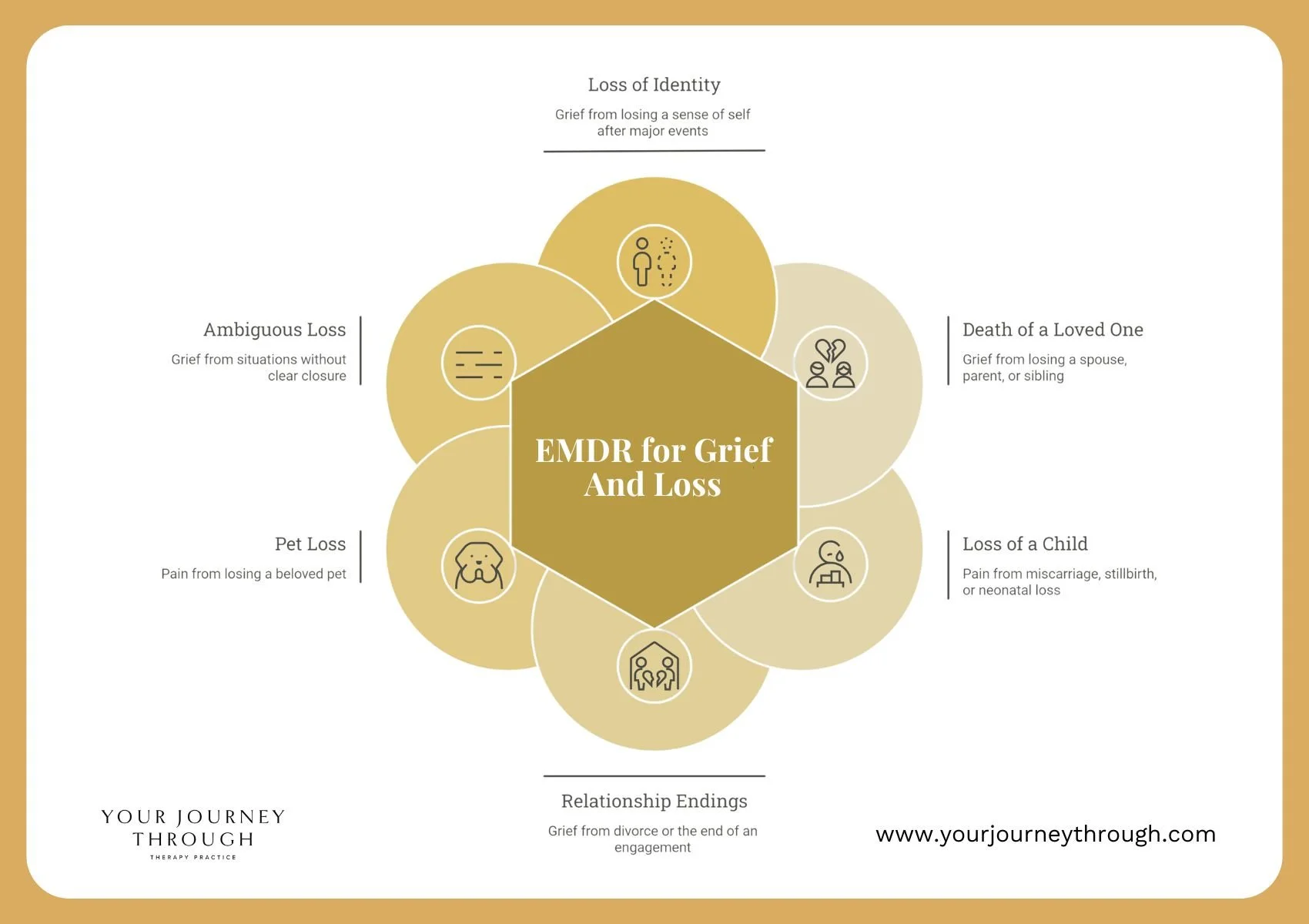
EMDR can be effective for grief related to:
The death of a spouse, parent, or sibling
Loss of a child, including miscarriage, stillbirth, or neonatal loss
Loss of a close friendship or long-term relationship
Loss of a pet, which is often more painful than others expect, and just as valid
Ambiguous loss, such as estrangement, a parent with dementia, or a relationship that ended without closure
Loss of identity or safety following a major life event, illness, or trauma
There is no hierarchy of grief. Whatever kind of loss brought you here, it's worth working on.
Insert graph here
Loss of a Child and Other Traumatic Losses
Some of the most layered grief work we do involves traumatic loss, and particularly the loss of a child. The grief that follows carries so much: the child you lost, the future you imagined, the identity of being their parent. And often, there is trauma woven through it that can feel impossible to approach directly.
This is exactly where EMDR therapy shines. It creates a structure for approaching what feels unapproachable, at a pace that is safe and carefully guided. You don't dive into the hardest memories on day one. The processing builds gradually, from a foundation of stability and trust.
The physical toll of grief also deserves attention. Research published in Psychosomatic Medicine found that bereaved people carry a 21 percent higher risk of heart attack in the period following a significant loss. Grief isn't just emotional. It lives in the body. EMDR works at that level too, addressing the physical tension, numbness, and somatic distress that grief often carries with it.
If depression has also become part of your experience since the loss, our work with EMDR therapy for depression addresses how grief and depression overlap and reinforce each other, and how to untangle both.
What to Expect from Your EMDR Sessions for Grief
Before any reprocessing begins, you'll have a toolkit. Grounding exercises, breathing techniques, and ways to bring yourself back to the present moment if things get too intense. These aren't extras. They're a core part of how EMDR therapy works and why it's safe.
Many clients who come in already using mindfulness, DBT skills, or other coping mechanisms find those integrate naturally into the EMDR process. If you've never had a grounding practice before, we'll build one with you.
Our work with EMDR for anxiety and our grief work overlap in useful ways here, because nervous system regulation looks similar regardless of what's driving the distress.
EMDR and CBT Together
EMDR doesn't exist in a vacuum at our practice. We often integrate it with other approaches depending on what each client needs. EMDR and CBT work well together: EMDR addresses the stuck emotional memories while CBT tools help reshape the thought patterns that grief tends to create, like "I'll never be happy again" or "nothing matters anymore."
For clients with a history of past trauma that's tangled up with their current grief, the standard EMDR protocol adapts to address those layers. The approach is always tailored to you and what you're actually carrying, not a one-size-fits-all method.
One thing we're proud of at our practice: we don't do awkward silences and generic advice. We show up as real people, working with real people, on things that are genuinely hard.
How many EMDR sessions does grief take?
The number of EMDR sessions for grief varies by person. Some clients notice meaningful relief in 6 to 12 sessions, while those working through traumatic or prolonged grief may benefit from longer-term therapy. Your therapist will pace the work based on your specific experience, history, and progress.
Life After Loss: What Healing Actually Looks Like
One of the biggest fears we hear from people considering EMDR for grief is this: "I don't want to stop loving them. I don't want to forget."
EMDR doesn't ask you to do either of those things. It doesn't erase memories. It doesn't sever connections. What it does is help the grief become something you can hold rather than something that holds you.
Grief researchers use the phrase "continuing bonds" to describe what healthy grief integration often looks like. Instead of being frozen at the moment of loss, you carry the person forward. The connection doesn't end. It just changes shape. What was acute pain can become something more like love in a different form.
We've watched clients go from being unable to say their loved one's name without dissociating to being able to share stories about them with a smile. That's not "getting over it." That's integration. That's what the natural healing process looks like when it's actually allowed to move.
What Changes After EMDR for Grief
After completing the processing work, clients often describe feeling lighter. Not empty, but lighter. The intrusive memories come less often. Triggers that used to send them spiraling stop having the same grip. They can think about who they lost and feel something other than only pain.
They also tend to reconnect with their own lives in ways that felt impossible before. Not because the loss stopped mattering, but because they've found a way to bring it with them instead of being stopped by it.
This is what the work of coping with grief and loss can look like when it goes beyond surviving. It's about building a relationship with your grief, rather than running from it indefinitely.
If you're also working through past trauma that's become intertwined with your current grief, our trauma therapy work and EMDR often address both simultaneously, since the brain tends to process them together anyway.
Grief Support at Your Journey Through
Grief is one of the most human experiences there is. And it's also one of the loneliest, especially when the people around you seem to think you should be "over it" by now.
At Your Journey Through, we work with people who are struggling with grief in all its forms: the recent, the years-old, the prolonged, the traumatic, and the kind that doesn't fit neatly into any category. Our therapists are trained in EMDR therapy in Raleigh, NC, and offer both in-person sessions at our Six Forks Road office and HIPAA-compliant teletherapy throughout North Carolina.
We're not the kind of practice that hands you a tissue and waits. We bring warmth, real conversation, and genuinely evidence-based tools to every session. We want you to feel like yourself again. Or maybe like a version of yourself who has learned to carry this weight differently.
If you're looking for EMDR therapy for grief and loss and you're ready to see what the healing process could actually look like for you, we'd love to connect. Reach out to schedule a free consultation, and let's figure out together what's possible.
