
How Many EMDR Sessions Does It Take? What to Expect from Your Treatment Plan
If you're considering EMDR therapy, chances are one of the first things on your mind is: how long is this actually going to take? That's not a shallow question. It's a practical one. You want to know what you're committing to before you say yes.
We hear this all the time from clients who come to us at Your Journey Through. And we'd rather give you a straight, honest answer than the usual "it depends" non-answer that leaves you more confused than before.
So here's what we can say from working with our clients: EMDR therapy is one of the most time-efficient trauma treatments available. Most people are surprised by how quickly they start to feel genuinely different. And the number of sessions you'll need is more predictable than you might think, if you know what factors are at play.
In this article, we'll walk you through:
The Short Answer: How Many EMDR Sessions?
What the First Few Sessions Feel Like
EMDR Session Count by Situation
Signs EMDR Is Working
What Speeds Up or Slows Down Your Timeline
Weekly, Twice-Weekly, or Intensive EMDR?
Does Insurance Cover EMDR Therapy?
EMDR vs. Talk Therapy: Why the Timeline Feels Shorter
How We Approach EMDR at Your Journey Through
How Many Sessions of EMDR Are Needed: The Short Answer
Most people who wonder how many EMDR sessions they need end up somewhere between 6 and 20 total. The American Psychological Association describes EMDR as an individual therapy typically delivered one to two times per week for a total of 6 to 12 sessions, though that range reflects single-issue trauma, not every situation.

Here's a more complete picture of what we see:
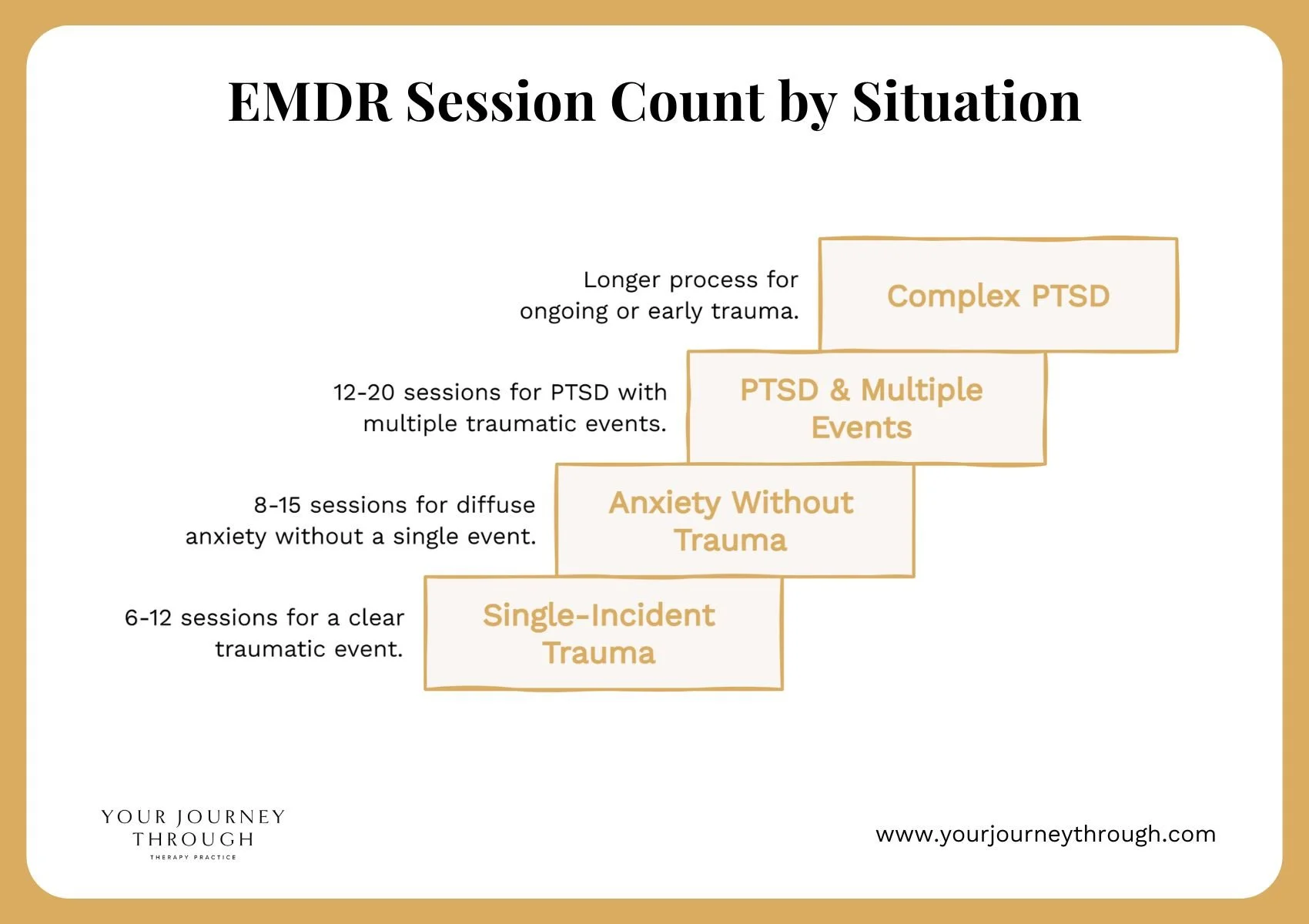
Single-incident trauma (one event, like an accident or assault): 6 to 12 sessions total
Anxiety without a clear single trauma: 8 to 15 sessions, depending on the number of targets
PTSD with multiple events: 12 to 20 sessions on average
Complex PTSD or childhood trauma: 20 or more sessions, with a longer preparation phase
These ranges aren't open-ended commitments. They have a beginning, middle, and end. And for many clients, meaningful shifts start showing up well before that last session.
Not sure if EMDR is right for you? We offer a free 20-minute consultation. No commitment, just a real conversation. Schedule yours here.
What the First EMDR Sessions Feel Like
A lot of people show up expecting to dive into the hard stuff immediately. The truth is a bit different. We think that's actually a relief once you understand why.
The 8 Phases of EMDR, Explained Simply
Eye movement desensitization and reprocessing follows an 8-phase structure. The EMDR International Association outlines these phases to make sure processing happens safely, at a pace your nervous system can actually handle. If you want a deeper look at each phase, we break it down fully in our guide to what EMDR therapy is and how it works.
Here's the quick version:
Phases 1 and 2 are preparation. We gather your history, identify what we'll work on, and build your grounding toolkit. This takes one to three sessions for most people.
Phases 3 through 6 are the active reprocessing work. Bilateral stimulation (side-to-side eye movements, tapping, or alternating sounds) helps your brain reprocess traumatic memories in a way it couldn't manage on its own. One memory might take one session. Others take two or three.
Phases 7 and 8 are closure and reevaluation. Did the work hold? Is the body still holding anything? Is the positive belief actually landing?
The preparation phases aren't wasted time. They're what make the reprocessing phases safe and effective. Skipping ahead never works out the way people hope.
After Your First EMDR Session
Something we hear a lot after a first EMDR therapy session: "I wasn't sure anything happened, but I felt different for the rest of the week." That's actually completely normal. Your brain keeps processing after you leave. Memories surface. Dreams shift. Emotions that have been frozen start to move.
Some people feel lighter after that first session. Some feel tired. Either way, it's information, and it usually means the process has begun.
Around the Third EMDR Session
By the third EMDR session, most clients notice a concrete shift. The memory we've been targeting feels less charged. You can bring it to mind without the same physical reaction you had before. Something that used to feel urgent starts to feel more like something that happened. Real, but no longer in charge.
We sometimes call this the "loosening." The memory hasn't disappeared. But it no longer has the same grip it did.
EMDR Session Count by Situation
If you're wondering how many EMDR sessions you might need, the most honest answer depends on what you're working through. Here's a more specific breakdown.
Single-Incident Trauma: 6 to 12 Sessions
When there's one identifiable event with a clear beginning and end, EMDR tends to move the fastest. Early EMDR trials found that, among adults with PTSD from a single traumatic event, roughly 84–90% no longer met diagnostic criteria after three 90‑minute EMDR sessions, with gains maintained at follow‑up.
In full practice, we typically see 6 to 12 sessions total when you factor in preparation and closure. For many clients, that's just a few months of weekly sessions to treat a memory that has been running their nervous system for years. Some clients need fewer sessions, and that's always a good thing.
Anxiety Without a Clear Traumatic Event
This one surprises people. If you're working through anxiety, EMDR can be highly effective even when there's no single defining trauma behind it. Anxiety often has roots in smaller moments that accumulated over time: a critical parent, years of feeling like you had to earn your place, an experience that got filed away as "proof" that you weren't good enough.
How many EMDR sessions for anxiety specifically? We typically estimate 8 to 15 sessions, depending on how many targets need processing. The preparation phase sometimes takes a bit longer, too, since we're building resources for more diffuse material rather than one clear event.
Even with complex anxiety histories, it's rare for clients to need more than 20 sessions total. The number of sessions you'll need is almost always less than people expect when they first walk through our door.
PTSD and Multiple Traumatic Events: 12 to 20 Sessions
Treating PTSD with EMDR takes longer when there are multiple events to process or when trauma has been stored in layers. People with PTSD often need to work through several target memories, and each one requires its own reprocessing time.
Research summarized in a peer‑reviewed meta‑analysis in Frontiers in Psychiatry shows EMDR’s strong effectiveness for PTSD. Across clinical trials and standard EMDR protocols, treatment courses for non‑complex PTSD are often in the range of about 8 to 12 sessions, with longer courses for more complex trauma presentations.
How long does EMDR take to work?
A typical course of EMDR therapy involves 6 to 12 sessions for single-incident trauma and 12 to 20 or more for complex trauma or PTSD. EMDR is an individual therapy typically delivered one to two times per week, with meaningful progress often appearing within the first few sessions.
Complex PTSD and Childhood Trauma: A Longer Process
Complex PTSD (when trauma is ongoing or started very early) requires more time. The nervous system needs more preparation before it's ready to reprocess. There are usually more memories that need attention, and they're more deeply woven into how you see yourself and the world.
We often tell clients working through complex trauma: we're not in a race. Some of the most important progress happens in the early sessions, before any formal reprocessing begins. Building enough internal stability that your system can actually handle the deeper work isn't a delay. It's the work.
Signs EMDR Is Working
Progress in EMDR therapy doesn't always announce itself loudly. More often, it shows up quietly in your everyday life before you even notice it in a session.
Here are the signs EMDR is working that we hear from clients most often:
The memory feels further away. It's still there, but it's like a photo that used to be right in your face is now across the room.
Triggers don't hit the same way. Something that used to send you spiraling now just passes through.
Sleep improves. Fewer nightmares. Easier to fall asleep. Waking up feeling less braced.
Old patterns start to feel optional. You notice them rather than being run by them.
You catch moments of calm that feel unfamiliar. And good.
We also track progress formally between sessions, monitoring how disturbing a target memory feels and how fully a positive belief has installed. But the functional changes clients notice outside the therapy room are just as meaningful as anything that happens inside it.
What Speeds Up or Slows Down Your Timeline
A few factors can meaningfully change how long EMDR takes. Some are within your control, and some are not.
What Helps EMDR Move Efficiently
Consistent attendance is the biggest one. EMDR builds on itself, and gaps between sessions mean spending part of the next session re-establishing where we left off instead of moving forward. Twice-weekly sessions can sometimes compress the timeline if you're stable and ready for that pace.
Sleep matters more than most people expect. Research in Frontiers in Psychology highlights how sleep and between‑session consolidation support emotional processing and integration, which is part of why good rest tends to make EMDR work move more smoothly. Your brain integrates what happened in session while you sleep. Chronic sleep deprivation slows the work noticeably.
Practicing the grounding skills from your early preparation sessions also helps. The more confident you are in settling your nervous system, the more capacity you bring to the reprocessing work.
What Slows Things Down
Active life stressors can stall progress. If you're navigating a custody dispute, a job loss, or an unsafe relationship, your nervous system is already in survival mode. It will prioritize present-day safety over processing the past. We might slow down or temporarily pause reprocessing until things stabilize. That's a clinical decision, not a failure.
High dissociation can also slow the timeline. EMDR requires staying present enough to process what's surfacing. If disconnection is a strong pattern for you, we'll invest more time in the preparation phase, building your window of tolerance, before moving forward. That extra foundation almost always leads to more efficient processing when we do begin.
Weekly, Twice-Weekly, or Intensive EMDR?
EMDR is an individual therapy typically delivered once a week, and that cadence works well for most situations. Weekly sessions give your brain time to continue processing between appointments and integrate what's shifting.
Twice-weekly sessions can accelerate the timeline if you're stable, motivated, and have the emotional bandwidth to go faster. We sometimes recommend this for clients working through a specific, targeted issue who want to move through it more quickly.
Intensive EMDR is a newer format that condenses multiple sessions into consecutive days. Sometimes a half-day for a few days in a row, or a dedicated long weekend. It works well for single-incident trauma when you have the time, support, and resources to commit that way. It's not right for everyone, and we'll talk through whether it makes sense for your situation.
There's no universally best frequency. We figure it out together based on your history, your nervous system, your life circumstances, and what you can realistically hold right now.
What stops EMDR from working?
EMDR can stall when someone is still in an actively unsafe environment, has high dissociation, or isn't yet stabilized enough for reprocessing. Ongoing life stressors, inconsistent attendance, and insufficient preparation can also slow progress. A skilled EMDR therapist will adjust the pacing rather than push through when the process gets stuck.
Does Insurance Cover EMDR Therapy?
This is a question we get often, especially from clients who are weighing their options and trying to understand the full picture before starting therapy.
We're an out-of-network practice, which means we don't bill insurance directly. But that doesn't mean insurance is out of the picture entirely.
How Our Superbill Process Works
After each session, we provide a superbill: a detailed receipt that you can submit directly to your insurance company to request reimbursement. Depending on your out-of-network mental health benefits, you may get a meaningful portion of each session cost reimbursed.
Whether EMDR therapy gets covered often depends on your specific plan and the diagnosis. Most major insurers recognize EMDR as an evidence-based therapy, particularly for treating PTSD, so coverage is more likely when that's your primary presenting concern. Anxiety-based presentations can vary from plan to plan.
We always recommend calling your insurance company before starting EMDR to ask specifically about out-of-network mental health benefits, your deductible, and what percentage they reimburse. We're happy to walk you through what to ask.
EMDR vs. Talk Therapy: Why the Timeline Feels Shorter
Clients who've spent years in traditional psychotherapy for PTSD or trauma sometimes arrive at our door with a specific frustration. They've worked hard. They've made real progress. But something about the trauma itself hasn't moved. The way they feel when they think about what happened is unchanged, even when the way they think about it has evolved.
That's the gap EMDR addresses.
Talk therapy works through insight, meaning-making, and shifting perspective. EMDR works through how traumatic memories are actually stored in the brain and body. It targets the distress that lives in the nervous system, not just the narrative. The result is that many clients see more progress in EMDR treatment in fewer sessions than they did in years of traditional therapy.
That's not a knock on talk therapy. Both approaches have real value, and we often combine EMDR with other modalities depending on what a client needs. Our work with EMDR and depression, for example, frequently incorporates cognitive work alongside bilateral stimulation, because the two support each other.
But if you've been circling the same material without it actually shifting, or if you can describe the trauma clearly but still feel hijacked by it, EMDR may be what finally moves it.
How We Approach EMDR at Your Journey Through
Starting EMDR therapy takes courage. It means showing up for some sessions that feel hard, trusting a process that can seem strange at first, and giving your nervous system time to do what it's built to do. We don't take that lightly, and we don't rush it.
What we can tell you is that the shift is real. It shows up in how you sleep, how you respond to the things that used to flatten you, how you feel in your own body when a memory surfaces. We've watched it happen for a lot of people, and it still doesn't stop being meaningful to us.
We offer EMDR therapy in person in Raleigh, NC, and HIPAA-compliant teletherapy throughout North Carolina. We're out-of-network and provide superbills for every session so you can pursue reimbursement through your insurance plan. We start every new client relationship with a free 20-minute consultation. No pressure, no commitment, just a conversation to figure out if we're a good fit.
If you've been wondering how many EMDR sessions you'd need, or whether starting EMDR therapy even makes sense for what you're carrying, reach out. We're here, and we'd love to talk.
