
EMDR Therapy for Trauma: How It Works and What to Expect
Something happened. Maybe it was one moment that changed everything. Or maybe it was a slow accumulation of experiences that wore you down over time. Either way, you've been carrying it. And no matter how hard you try to move on, parts of it keep showing up in your body, your relationships, your sleep, the way you flinch at things others barely notice.
If you've been looking for a way through it that does not involve retelling the whole story over and over, EMDR for trauma may be worth exploring. Here's what this article covers:
How EMDR helps trauma survivors
Which types of trauma respond to EMDR
What a real session feels like
How long trauma recovery with EMDR takes
How to know if it's the right fit for you
How EMDR Therapy Helps with Trauma
Eye Movement Desensitization and Reprocessing (EMDR) is a form of psychotherapy developed by Dr. Francine Shapiro in the late 1980s. It was originally designed to treat post-traumatic stress disorder, and it remains one of the most well-researched trauma treatments available today.
The World Health Organization, the American Psychological Association, and the US Department of Veterans Affairs all recognize EMDR as an effective treatment for trauma and PTSD. That is a meaningful endorsement.
Here's the core of how it works: traumatic memories can be encoded and recalled differently from ordinary memories, especially when the nervous system was overwhelmed at the time. When something overwhelming happens, the brain sometimes can't process it fully in the moment. The memory gets frozen, stored with all the original emotions, physical sensations, and negative beliefs attached. Long after the event is over, anything that resembles it can trigger the whole thing again.
EMDR therapy works by helping the brain go back and finish processing what it couldn't at the time. Using bilateral stimulation, usually guided eye movements where you follow your therapist's fingers, the therapy activates the brain's natural healing process. The distressing memory gradually loses its emotional charge. It doesn't disappear, but it stops feeling like it's happening right now.
Can EMDR work if I don't remember my trauma clearly?
Yes. EMDR works with the feelings, body sensations, and negative beliefs connected to distressing experiences; a clear or complete memory isn't required. Your therapist will guide the process based on whatever is present for you.
Why EMDR Is Different from Traditional Talk Therapy
With traditional talk therapy, healing often happens through conversation. You talk about what happened, explore how it affected you, and build a new understanding over time.
EMDR does something different. You don't have to describe the traumatic event in detail. You don't have to relive it through words. The processing happens through a structured therapeutic protocol that includes bilateral stimulation while you briefly hold the memory in mind. For many trauma survivors, this is a genuine relief, especially when the words just don't come easily.
EMDR for Trauma: Which Experiences Does It Treat?
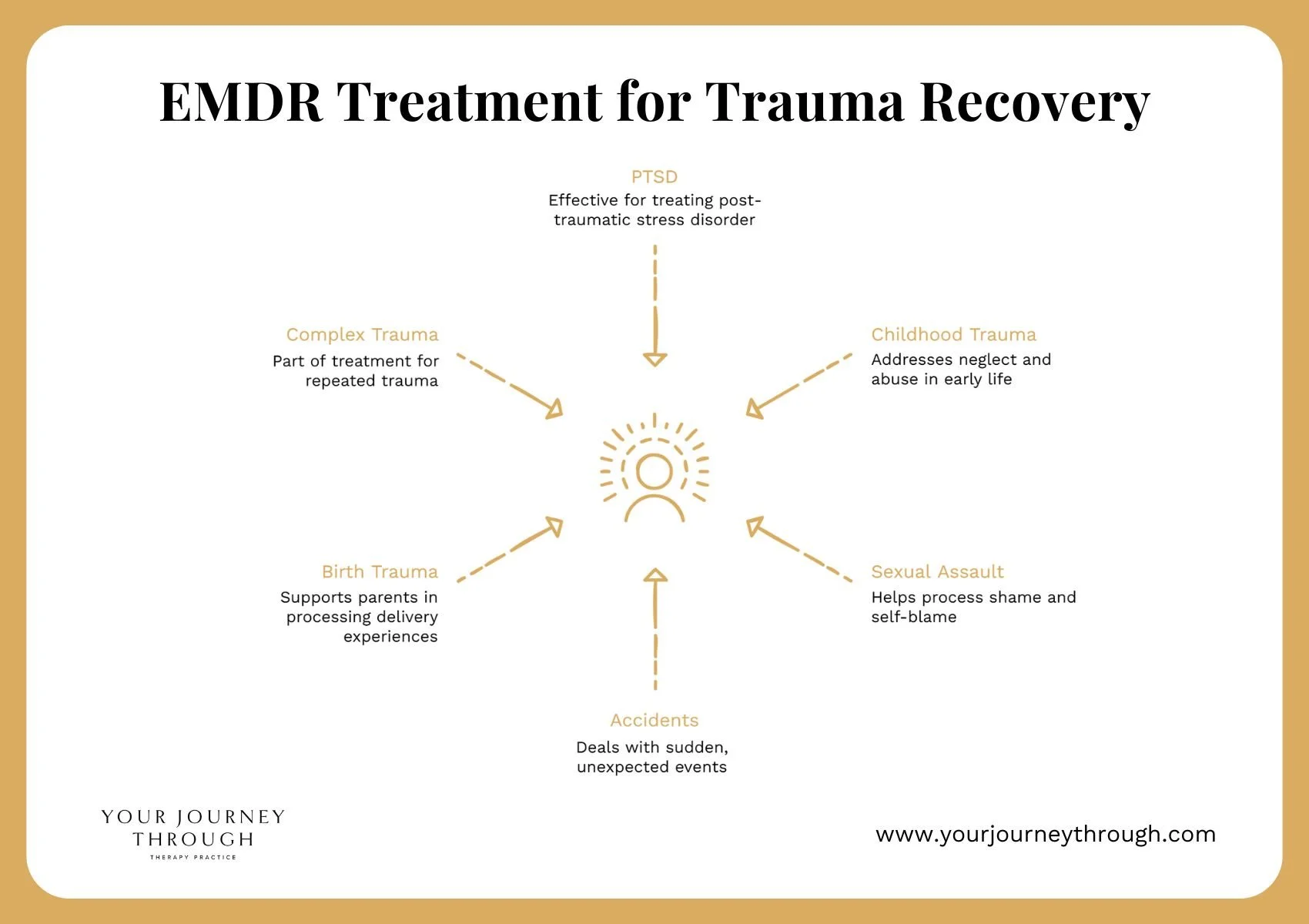
EMDR treatment is especially effective for trauma recovery across a wide range of mental health conditions and experiences. It's not just for combat veterans or survivors of single catastrophic events. It works for:
Post-traumatic stress disorder (PTSD). The most researched application, with strong evidence across dozens of randomized controlled trials.
Childhood trauma. Including neglect, emotional abuse, and adverse life experiences that shaped how you see yourself and the world.
Sexual assault and relationship abuse. Processing experiences that carry deep shame and self-blame.
Accidents, medical trauma, or sudden loss. Events that came without warning and left the nervous system stuck in high alert.
Birth trauma. For some parents, EMDR may help process distressing memories, fear, shame, or body-based reactions connected to a traumatic delivery.
Complex or repeated trauma. EMDR may be part of treatment for complex trauma, though the preparation phase is often longer and the work may need to move more gradually.
One thing that often surprises people: you don't need a PTSD diagnosis to benefit from EMDR. If a past experience is still affecting how you feel, function, or relate to others, it's worth exploring.
The Process Behind EMDR for PTSD and Trauma
EMDR follows a structured eight-phase process. You don't need to know every phase by heart, but understanding the shape of it can help you walk in feeling prepared rather than uncertain.
Phases 1 and 2: Getting Ready
The first two phases are all about preparation. Your therapist gets to know your history, identifies the memories and experiences to target, and teaches you grounding and stabilization techniques. Nothing is processed until you have real tools to manage distress, and until you feel safe enough to use them.
Phases 3 to 6: Active Processing
This is where the actual trauma processing happens. Your therapist helps you identify:
A specific target memory
The negative belief connected to it (e.g., "It was my fault," "I'm not safe")
The body sensations and emotional distress that come up when you think about it
A positive thought you'd rather believe instead
Then the bilateral stimulation begins. You hold the memory in mind while following your therapist's eye movements, taps, or sounds. After each set, your therapist checks in. The process continues until the distress drops to near zero, and the positive belief feels genuinely true.
Phases 7 and 8: Closing and Review
Each session ends with a closure phase that brings you back to a steady baseline before you leave. The following session opens with a review. Your therapist checks in on how the week felt and whether the processing held.
What kind of trauma is EMDR best for?
EMDR is most widely used for PTSD and single-event trauma, but it's also effective for childhood trauma, complex trauma, medical trauma, and adverse life experiences that don't fit neatly into a diagnosis. If a past experience is still affecting your daily life, EMDR may help.
What Happens During EMDR Therapy for Trauma
The early sessions are slower. Your therapist is building a picture of your history, identifying what needs attention, and making sure you have enough stability to handle what comes up. This isn't wasted time. It's what makes the processing safe.
What Processing Feels Like
Once you're in the active phases, a typical EMDR session might look like this:
You bring a target memory to mind, along with the negative belief and any body sensations
You follow your therapist's finger movements with your eyes, or track taps or tones
Your mind moves where it goes, without any pressure to force a particular outcome
After each set, your therapist asks what you noticed — a new memory, a thought, a feeling, a physical sensation. Anything is valid
Over the course of the session, the emotional charge around the memory gradually loosens
People often describe it as watching the memory from a distance for the first time. Something that used to feel immediate and overwhelming may begin to feel more like something that happened.
After a Session
It's normal to feel tired, emotionally stirred up, or more reflective than usual after an EMDR session. Vivid dreams or unexpected memories surfacing between sessions are common. These are signs that processing is continuing, and they usually settle within a day or two.

EMDR Trauma Processing: How Long Does It Take?
The number of EMDR sessions varies depending on your history and what's being targeted. For a single traumatic event, meaningful progress can happen in as few as 6 to 12 sessions. Complex or repeated trauma typically takes longer.
For some people, that is faster than they expected from therapy. The structured nature of EMDR, targeting specific memories rather than exploring general themes, tends to move things along more efficiently than open-ended talk therapy.
A few things that affect the timeline:
The complexity of your trauma history. One event is generally quicker to process than years of repeated adverse experiences.
Your current level of stability. More time in the preparation phases means safer, more effective processing later.
How your nervous system responds. Some people process quickly; others need more time between sessions to integrate what's come up.
Sessions are typically 60 to 90 minutes. Online EMDR is also a well-established option if getting to an office is a barrier. Therapists can offer EMDR via telehealth using screen-based bilateral stimulation tools. Online EMDR can work well for many people, but it is not the right fit for everyone, so your therapist should assess privacy, safety, grounding skills, and clinical stability first.
What are the benefits of EMDR therapy?
The benefits of EMDR include faster trauma processing compared to traditional talk therapy, reduced emotional distress, and the ability to reprocess traumatic memories without reliving them in detail. Many people notice lasting relief within a structured treatment plan of 6 to 12 sessions.
Is EMDR Trauma Therapy Right for You?
EMDR is a good fit if any of these feel familiar:
You've tried other approaches, and something still feels stuck
You find it hard to talk about what happened in detail
Trauma symptoms keep showing up even when life is otherwise going well
You want a structured, evidence-based path forward rather than open-ended exploration
It's worth knowing what EMDR doesn't require. You don't need a formal PTSD diagnosis. You don't need to remember events clearly or in chronological order. You don't need to be in crisis. EMDR meets you where you are.
A systematic review of randomized controlled trials found that EMDR reduced PTSD symptoms and helped some clients no longer meet criteria for a PTSD diagnosis. The evidence is there.
Ready to Start Your Trauma Recovery?
You do not have to keep carrying this in the same way. EMDR therapy offers a structured path forward that does not ask you to endlessly retell what happened. Instead, it helps your brain and body process what still feels unresolved.
At Your Journey Through, our EMDR therapists work with trauma in all its forms: childhood experiences, PTSD, relationship trauma, medical trauma, and everything in between. We see clients in person at our Raleigh, NC trauma therapy practice and via online therapy throughout North Carolina.
Not sure if EMDR is right for what you're dealing with? Reach out to schedule a free consultation. We'll talk through where you are and whether this is the right next step for you.