
EMDR Therapy for Depression: What the Research Actually Shows
Depression has this way of making everything feel slightly out of reach. Not dramatic. Not crisis-level. Just muted, like you're watching your own life through frosted glass and can't quite get back to yourself.
For a lot of people, that feeling doesn't fully lift with talk therapy or medication alone. It eases, then comes back. Or it just sits there, quieter than a crisis but louder than background noise. If that's where you are, EMDR therapy for depression might be worth understanding.
Not because it's a cure. But because it works at a level that language-based therapy sometimes can't reach.
In this post, we're covering:
What depression actually is and how EMDR approaches it
Why trauma and adverse life experiences fuel depressive symptoms
What the research says (and what it doesn't)
What EMDR sessions look like when treating depression
Who tends to benefit most
How to find a qualified EMDR therapist
If you've been wondering whether EMDR could help with depression, keep reading.
What Is Depression, and Why Doesn't It Always Respond to Treatment?
Depression is one of the most common mental health conditions in the world, affecting over 332 million people globally. But it's not one thing. It shows up differently in different people, and it doesn't always respond to the same treatments the same way.
Common Symptoms of Depression
Most people know the low mood. But depression is often more than sadness. Common depressive symptoms include:
Persistent sadness or emptiness that doesn't lift, even on good days
Anhedonia: losing interest or pleasure in things you used to enjoy
Changes in sleep: either too much or not nearly enough
Feelings of worthlessness or excessive guilt
Difficulty concentrating or making decisions
Rumination: the same negative thoughts looping over and over
Changes in appetite or weight
Thoughts of death or suicide in more severe cases
A diagnosis of major depression typically requires these symptoms to be present for at least two weeks and to interfere meaningfully with daily life. But plenty of people live with a quieter, longer-lasting form of depression (what we'd call chronic or persistent depression) without ever hitting that acute threshold.

Why Some Depression Doesn't Respond to Standard Treatments
Medication and talk therapy help a lot of people. And both are part of our toolkit. But they don't work for everyone, and for some people, the relief is temporary. The depression comes back. The same patterns resurface.
One major reason for this is that standard treatments often work at the level of symptoms or thought patterns, but don't always reach the underlying memories and experiences that are driving those patterns in the first place. That's where EMDR comes in.
Why Depression and Trauma Are More Connected Than Most People Think
Here's something that surprises a lot of people: depression is very often rooted in what the trauma field calls adverse life experiences. These aren't always dramatic single events. Sometimes they're things like:
These experiences don't always look like "trauma" from the outside. But inside the brain, they can leave memories and negative beliefs sitting in an unprocessed state, biologically active and quietly contributing to depressive symptoms like hopelessness, fatigue, and low self-worth.
When the Brain Gets Stuck
EMDR therapy is built on a model called Adaptive Information Processing (AIP), developed by EMDR founder Francine Shapiro. The core idea is that the brain has a natural ability to process and file away difficult experiences. But sometimes, especially when something happens that's too overwhelming or happened too young, that process gets interrupted.
Those unprocessed memories stay frozen in their original form, complete with the emotions, body sensations, and negative beliefs attached to them. So when something in the present triggers a similar feeling, the brain doesn't just feel sad. It feels the original pain all over again, as if it's still happening.
This is a big part of why some depression doesn't respond to talk therapy or medication alone. You can understand why you feel the way you do and still feel it. EMDR works at the level where those memories are actually stored.
Does EMDR help with depression that isn't related to trauma?
This is a common question. EMDR was originally developed for post-traumatic stress disorder, but the underlying model (that unprocessed adverse experiences drive symptoms) applies more broadly than classic trauma. Even experiences that don't meet the clinical definition of a traumatic event can leave memories stored in a way that fuels depression. The key is identifying what experiences are acting as episode triggers for your specific depression. A trained EMDR therapist can help you map that out.
What EMDR Therapy for Depression Actually Does
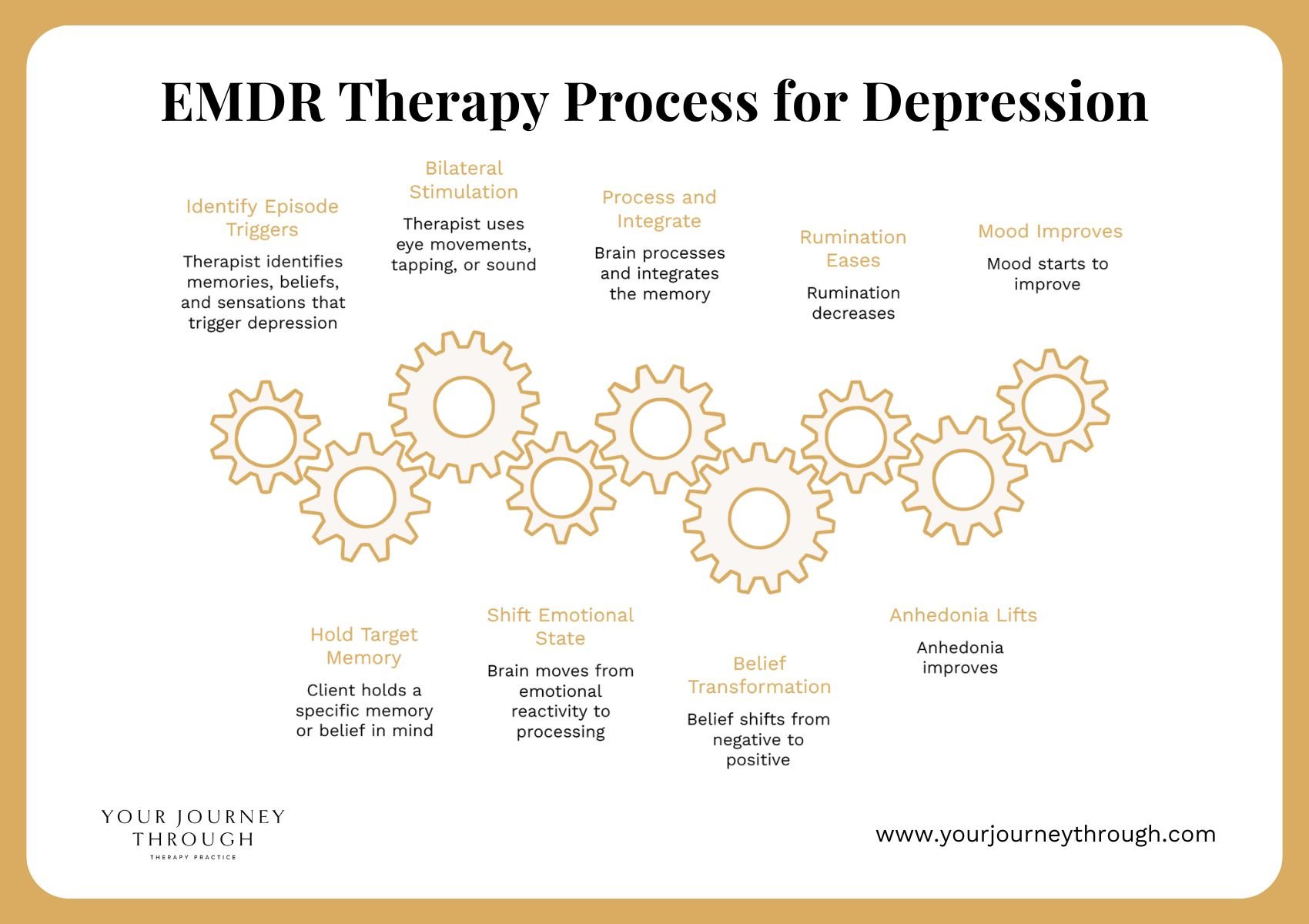
EMDR stands for Eye Movement Desensitization and Reprocessing. It's a structured form of psychotherapy that uses bilateral stimulation (most often guided eye movements, though tapping or sound can also be used) while the person briefly holds a target memory or belief in mind.
The bilateral stimulation appears to help the brain shift out of the emotional, reactive state and into a mode where it can actually process and integrate what happened. Think of it like helping the brain finish a sentence it started years ago but never got to complete.
How EMDR Specifically Targets Depression
When treating depression with EMDR, the therapist isn't just targeting one traumatic event. They're working to identify what researchers call episode triggers: the memories, experiences, and negative beliefs that spark or sustain depressive episodes.
This might include:
Memories tied to shame, failure, or abandonment that replay when depression hits
Negative core beliefs like "I'm not enough" or "nothing ever works out for me" that feed depressive thinking
Body sensations like heaviness in the chest or tension in the throat that get activated alongside the mood
Current triggers that connect back to older painful experiences
Here's what that transformation can look like in practice: a client might come in carrying the belief "I'm powerless." Over the course of EMDR reprocessing, that belief often shifts organically to something like "I can handle what comes now." Not because we argued them into it, but because the memory driving that belief lost its charge.
When the underlying memories are processed, something tends to shift. The rumination eases. The anhedonia lifts. The mood starts to move. Not because we talked about it, but because the brain was finally able to finish the work it started.
EMDR vs. Traditional Talk Therapy for Depression
Traditional talk therapy, including cognitive behavioral therapy (CBT), does a lot of things well. It helps people identify distorted thinking patterns, build coping skills, and understand their behavior. We use CBT regularly, and it has strong research behind it.
But EMDR works at a different level. Rather than changing what you think about a memory, it changes how the memory is stored. The result is often that clients don't need to keep managing the same thoughts over and over. The emotional charge that was driving them has actually been resolved.
For people with depression that's rooted in unprocessed experiences, that distinction matters a lot.
What Does the Research Say About EMDR and Depression?
The research on EMDR for depression is promising, but we want to be straight with you: it's still growing. Here's what the studies actually show.
Strong Evidence for Symptom Reduction
A 2024 meta-analysis published in the Journal of Clinical Medicine reviewed 25 randomized controlled trials with over 1,000 participants. The findings were clear: EMDR significantly reduced depressive symptoms, with particularly strong effects in severe and chronic cases. The researchers highlighted its potential as a non-pharmacological option, especially for treatment-resistant depression.
Earlier, a matched pairs study published in Brain and Behavior found that EMDR added meaningful benefit beyond standard care alone, with the EMDR group showing significantly lower depression scores at discharge, and fewer relapses over a follow-up period of more than a year.
How is EMDR different from CBT for depression?
Several randomized controlled trials have compared EMDR directly to trauma-focused CBT for depression. One study found that in cases of treatment-resistant depression, EMDR showed greater efficacy. Importantly, the improvements in the EMDR group held at follow-up more consistently than in the CBT group, a detail that matters a lot for people who've experienced depression that keeps coming back.
That doesn't mean EMDR is better for everyone. But for people whose depression stems from past trauma and adverse experiences, it may reach deeper than cognitive approaches alone.
What the Research Doesn't Say
The research base for EMDR and depression is smaller than for PTSD, and more standardized long-term studies are still needed. EMDR won't be the right fit for every person with depression, and it works best as part of a thoughtful treatment plan: sometimes alongside medication, sometimes alongside other therapy approaches.
What the evidence does support: EMDR therapy is a legitimate, clinically supported approach to depression, especially where adverse life experiences play a role. The World Health Organization and the American Psychological Association both recognize EMDR as an evidence-based treatment, and research specific to depression continues to grow.
Can EMDR make depression worse before it gets better?
During active reprocessing, it's possible to feel temporarily heightened emotions. For most clients, this is a sign the process is working, and it tends to be intense but manageable, especially when the therapist has prepared you well and closes sessions carefully. Between sessions, emotions or memories may continue to surface for a day or two. We always equip clients with grounding tools and encourage them to reach out if something feels overwhelming.
Types of Depression That EMDR May Help
One question we hear often: Does my kind of depression even qualify for EMDR? The answer is that depression rarely lives in one neat box. But here's where EMDR tends to show the most promise.
Depression Rooted in Trauma
If your depression came on after a loss, a difficult relationship, childhood experiences, or a traumatic event, EMDR may be particularly well-suited for you. The connection between trauma and depression is well-documented, and addressing the underlying trauma directly often brings relief that other treatments haven't.
It's also worth knowing that depression and post-traumatic stress disorder frequently co-occur. Many people who come to us for depression are also carrying PTSD symptoms without having named it that way.
Chronic or Recurrent Depression
For people living with chronic depression or who've experienced multiple depressive episodes and feel like they can't stay out of the low for long, EMDR targets what researchers call "episode triggers": the specific memories and beliefs that restart the cycle. This is the logic behind a specialized approach called the DeprEnd protocol, developed specifically for chronic and recurrent depression.
Treatment-Resistant Depression
If you've tried medication and multiple types of therapy without lasting relief, EMDR might offer a different pathway. Unlike approaches that work primarily through insight or language, EMDR works at the neurobiological level, changing how memories are stored, not just how they're understood. This lets it reach places that talk-based treatments sometimes can't.
We see this fairly often: clients who've done years of solid work in therapy and on medication but still feel stuck in certain patterns. When EMDR gets introduced into the picture, something shifts that hadn't moved before.
Depression Alongside Anxiety
Depression and anxiety disorders often travel together. EMDR can address both because the underlying mechanism is the same: unprocessed experiences that keep the nervous system in a state of chronic activation. If you've been managing both, EMDR for anxiety works through the same process as EMDR for depression. The same sessions can address both.
How many EMDR sessions does it take to treat depression?
There's no one-size-fits-all answer. Research suggests that for depression tied to a single clear event, meaningful relief can come within 4 to 8 sessions. For chronic, recurrent, or complex depression with multiple contributing experiences, treatment typically takes longer. The pace is always set in collaboration with your therapist, based on your readiness and how the processing is going. It's not a race.
What EMDR Sessions Look Like When You're Treating Depression
One thing that helps people feel ready is knowing what to actually expect. EMDR follows an eight-phase protocol, but the experience is more relational and client-led than the word "protocol" might suggest.
Before Any Reprocessing Begins
The first sessions aren't about jumping into difficult memories. We spend time getting to know you: your history, what your depression feels like, what seems to trigger it, and what strengths and resources you already have. We also make sure you have enough grounding and coping tools to feel stable before any deeper work begins.
This preparation phase isn't filler. It's what makes reprocessing safe, and a good EMDR therapist won't skip it or rush it.
During the Reprocessing Sessions
When reprocessing begins, your therapist will ask you to hold a specific memory or belief in mind, something that connects to your depression, while following a series of guided eye movements or another form of bilateral stimulation.
You stay present with whatever comes up: images, thoughts, emotions, body sensations. Your therapist guides the sets of eye movements and checks in with you between each one. The process is collaborative. You're in control of the pace. You're not just lying there while something happens to you. You're an active participant throughout.
After Sessions
It's normal to feel tired after EMDR. Sometimes emotions or memories continue to process on their own for a day or two afterward. Sessions always close in a contained way, and we make sure you leave with grounding tools to support yourself in the meantime.
Most people doing EMDR for depression work in 60 to 90-minute sessions. For depression connected to a single clear event, meaningful relief can come within 4 to 8 sessions. For chronic or recurrent depression with multiple contributing experiences, more sessions are typically needed.

Is EMDR Right for You? A Few Things to Consider
EMDR isn't for everyone, and any good therapist will say that.
EMDR May Be a Good Fit If:
Your depression feels connected to past experiences, even if you can't always name them clearly
You've tried talk therapy and feel like you understand your patterns, but can't shift them
Medication hasn't been enough, or you'd like to explore a non-pharmacological option
Your mood is tied to specific memories, people, or situations that trigger a disproportionate emotional response
You're carrying both depression and anxiety, or depression and PTSD together
EMDR Requires Some Stability First
EMDR involves activating difficult emotions, and that requires a foundation of stability. If you're currently in acute crisis, experiencing active suicidal ideation, or have unmanaged severe dissociation, EMDR may not be the right starting point right now. Getting stable enough to do the deeper work is a worthy and important goal on its own.
A qualified EMDR therapist will assess readiness with you and won't push you into reprocessing before you're ready. If you're unsure whether you're a good candidate, the best first step is simply having a conversation.
We also want to name something that doesn't come up often enough: EMDR can feel strange at first. The eye movements, the bilateral stimulation. It doesn't look like traditional therapy. Strange doesn't mean wrong. Most clients find that within a few sessions, it starts to feel natural, and the results tend to speak for themselves.
Does EMDR work for mood disorders beyond depression?
EMDR for mood disorders is an expanding area of research. EMDR has been studied and used for a range of mood-related conditions, including anxiety disorders, PTSD with co-occurring depression, and grief. Research and clinical experience both suggest that wherever unprocessed adverse experiences are contributing to mood symptoms, EMDR has potential. If you're managing a mood disorder and wondering whether EMDR applies to you, that's exactly the kind of conversation we can have in an initial consultation.
EMDR and Other Depression Treatments: What Works Together
EMDR doesn't have to replace anything you're already doing. It often works best as part of a broader treatment plan.
EMDR Alongside Medication
Being on antidepressants doesn't disqualify you from EMDR. Research supports using both together. The one nuance is that heavy sedation or significantly blunted affect can reduce the effectiveness of reprocessing. EMDR relies on being able to access emotional responses, not just think about them. If medication is dampening your emotional access significantly, it's worth discussing with both your prescriber and your EMDR therapist.
EMDR Alongside CBT and Other Modalities
We often integrate EMDR with CBT and other therapy approaches. They complement each other well. CBT builds awareness, skills, and new thought patterns. EMDR addresses the underlying memories that CBT can't always fully reach. For many clients, both together produce better outcomes than either alone.
At Your Journey Through, the goal is always your well-being, not loyalty to any one approach. We look at what you need and build from there.
Could EMDR Be Right for You? Let's Find Out Together
We know that reaching out for help when you're depressed is hard. Everything about depression: the fatigue, the hopelessness, the sense that nothing will really change. All of it makes the very act of picking up the phone feel pointless. We get that.
What we also know is that we've sat with a lot of people who felt exactly that way, and something shifted. Not because we said the right things, but because we did the actual work together.
At Your Journey Through, our EMDR therapy is offered alongside a full range of options for depression, including trauma therapy and teletherapy throughout North Carolina. We don't use one-size-fits-all approaches. We look at you: your history, your nervous system, what's already been tried. And we build a plan from there.
Our team is credentialed, warm, and as relatable as therapists come. We're not going to make you feel like a case to be managed. We're going to show up as people who know this work, care about you, and won't waste your time.
If you've been struggling with depression and are curious whether EMDR might be part of the answer, we'd love to talk. You can book a free consultation here, or reach us at hello@yourjourneythrough.com or (919) 296-3487.
You don't have to have it all figured out before you call. That's what the first conversation is for.