
What Is EMDR Therapy?

Maybe you've heard the term EMDR therapy thrown around and thought, "That sounds intense." Or maybe someone mentioned it, and you're genuinely curious whether it might help you. Either way, you're in the right place.
EMDR stands for Eye Movement Desensitization and Reprocessing, and yes, that's a mouthful. But the experience itself is often described as surprisingly gentle, even by people who've been carrying heavy things for a long time.
Here's what you actually need to know about how EMDR therapy works, what it treats, and what it feels like to sit in that chair.
What EMDR therapy is and how it works
The eight phases of EMDR therapy
What a real session looks like
What EMDR treats (it goes beyond PTSD)
Whether it might be right for you
What Is EMDR Therapy, Exactly?
EMDR therapy is a structured form of psychotherapy designed to help people process distressing memories, the kind that get stuck and keep showing up in your body, your relationships, and your day-to-day life.
It was developed by Francine Shapiro in the late 1980s after she noticed that certain eye movements seemed to reduce the emotional charge of her own distressing thoughts. Since then, it's grown into one of the most researched and evidence-based approaches in psychotherapy treatment.
EMDR therapy is designed to target traumatic memories at the root, not just the symptoms they create. Instead of talking through what happened over and over (like in traditional talk therapy), EMDR uses bilateral stimulation to help your brain do something it couldn't quite do on its own: file the memory away as something that happened in the past, rather than something that's still happening right now.
Is EMDR therapy an effective treatment?
Yes. The effectiveness of EMDR therapy is backed by decades of research. It's recognized as an evidence-based treatment for PTSD by the Department of Veterans Affairs, the Department of Defense, and the American Psychiatric Association, among others.
How Does EMDR Work?
When something traumatic or deeply distressing happens, your brain sometimes doesn't process it the way it does ordinary memories. The memory gets stored with all its original intensity: the images, the body sensations, the emotions, the negative beliefs about yourself. That's why trauma can feel so vivid and present, even years later.
EMDR work begins by activating that stuck memory while simultaneously engaging in bilateral stimulation, usually guided eye movements, but sometimes tapping or auditory tones. The dual focus seems to allow the brain to reprocess the memory without being overwhelmed by it.
Think of it like this: the memory doesn't disappear, but it stops having the same emotional grip. What felt unbearable starts to feel like something you lived through and survived.
What Is Bilateral Stimulation?
Bilateral stimulation is the back-and-forth sensory input that drives EMDR processing. Your EMDR therapist might:
Ask you to follow their finger or a light bar with your eyes (guided eye movements)
Use gentle tapping on your hands or knees
Use audio tones that alternate between your left and right ear
Researchers believe this mimics what happens during REM sleep, the phase where your brain naturally processes and files the events of the day. For people whose nervous systems are stuck in high alert, EMDR essentially helps the brain finish what it started.
What Does EMDR Therapy Treat?
EMDR was originally developed to treat post-traumatic stress disorder (PTSD), and that's still where most of the research lives. The Department of Veterans Affairs and the Department of Defense both formally endorse EMDR as a first-line, evidence-based treatment for PTSD. The American Psychiatric Association recognizes it as an effective treatment, too.
But EMDR therapy may be used for far more than post-traumatic stress disorder alone:
Trauma from childhood, abuse, accidents, or loss
Depression
OCD
Grief
Phobias
Negative beliefs about yourself ("I'm not enough," "I'm not safe," "I'm to blame")
Distressing life experiences that don't meet the "official" trauma threshold but still hurt
If your mind keeps circling back to something, like a memory, a feeling, a story you tell yourself about who you are, EMDR may be worth exploring.
The Eight Phases of EMDR Therapy
EMDR therapy is a structured approach built around eight phases of EMDR therapy. That might sound rigid, but in practice, it moves at your pace. Your therapist isn't rushing you through anything.
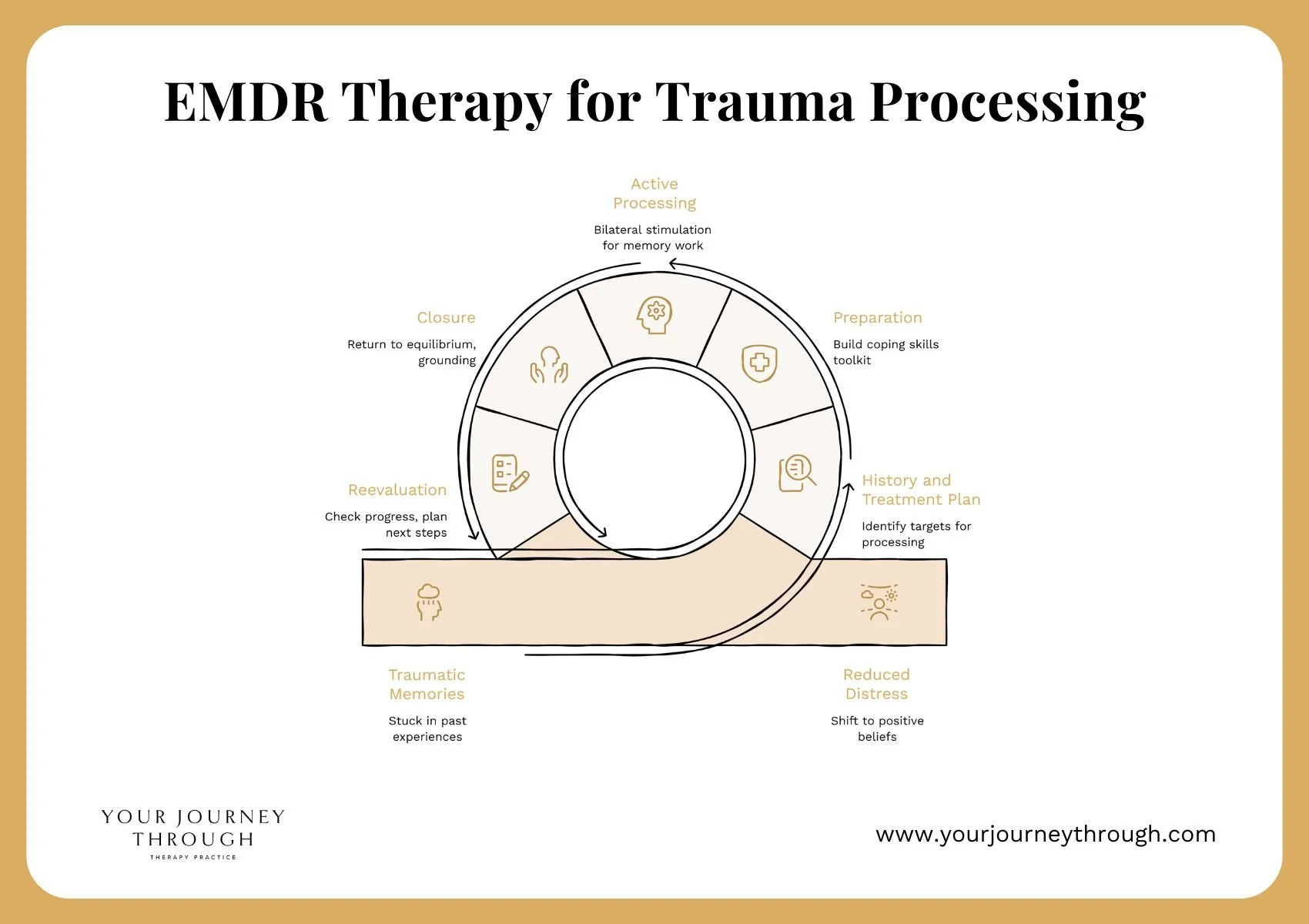
Phase 1: History and Treatment Plan
The first phase of EMDR therapy is about getting to know you. Your EMDR therapist will ask about your history, your current struggles, and what you want to work on. Together you'll identify the targets for EMDR processing, the specific memories or experiences at the core of what's keeping you stuck.
Phase 2: Preparation
Before any memory work begins, your therapist helps you build a toolkit of coping skills and grounding techniques. The goal is to make sure you feel stable and resourced enough to go into the material without being destabilized by it.
Phases 3 to 6: Assessment, Desensitization, Installation, Body Scan
This is the active processing work. You'll call up a specific memory, such as a mental image, the negative belief attached to it, and where you feel the distress in your body. Then the bilateral stimulation begins. Your EMDR therapist guides you through sets of eye movements or tapping while you let your mind go where it goes. You're not directing the process; you're just noticing.
Over time, the distress associated with traumatic memories reduces. Then you work on installing a positive belief in its place, shifting from "I'm powerless" to "I handled it" or "I'm safe now." A body scan checks whether any lingering body sensations remain.
Phase 7: Closure
Each EMDR session ends with a return to equilibrium. Your therapist will make sure you're grounded before you walk out the door, whether the memory has been fully processed in that session or not.
Phase 8: Reevaluation
The final phase of EMDR therapy revisits earlier targets to check what's shifted, what still needs attention, and where to go next in your work together.
What does an EMDR session feel like?
Most people describe EMDR sessions as more active than regular therapy but less emotionally overwhelming than they expected. You'll notice thoughts, images, and body sensations shifting as processing happens. Your therapist checks in throughout and makes sure you're grounded before you leave.
EMDR Therapy Examples: What a Session Actually Looks Like
A typical EMDR session runs 60 to 90 minutes. Here's how it usually goes:
You check in with your therapist about how you've been since the last session
You identify the memory or target you're working on today
Your therapist walks you through the assessment — the image, the negative belief, where you feel it in your body, and how distressing it is on a scale of 0 to 10
Bilateral stimulation begins — usually in short sets, with brief check-ins between each one
You report what comes up (images, thoughts, body sensations) without analyzing it
The session closes with grounding and a note about where to pick up next time
You don't have to describe every detail of what happened to you. You don't have to relive it in graphic terms. Many people find this to be one of the biggest differences from traditional talk therapy: you can process something without narrating it out loud.
Wondering what it feels like to start something new in therapy? Our guide on how to prepare for your first therapy session is a good place to start.
How Many Sessions Does EMDR Take?
Research suggests many people experience meaningful relief in as few as 6 to 12 sessions. Some studies on PTSD have found significant symptom reduction in around 12 sessions. That said, everyone's different — more complex trauma histories or layered mental health conditions may take longer.
Part of what makes EMDR different from open-ended talk therapy is its targeted, phase-based structure. Each session has a clear purpose, and progress is tracked. It often moves faster than people expect.
Is EMDR Right for You?
EMDR therapy is worth considering if:
You've tried talking about something but feel like it hasn't moved
Certain memories, flashbacks, or feelings keep coming back
You react strongly to things that "shouldn't" bother you as much as they do
You're dealing with trauma, PTSD, anxiety, or distressing life experiences that feel lodged in your body
You want to work on negative beliefs about yourself that feel impossible to shake
EMDR is also sometimes combined with other approaches — somatic therapy, for example, shares a similar interest in how the body holds distress. You can read more about the power of somatic therapy here.
EMDR isn't the right fit for everyone, and a good EMDR therapist will help you figure out whether it makes sense for where you are right now. The goal is always a plan that actually fits you.
Can EMDR help with things other than PTSD?
Absolutely. EMDR therapy may be used for anxiety, depression, OCD, grief, phobias, and distressing memories that don't fit neatly into any diagnosis. If something from your past is affecting your present, it's worth talking to an EMDR therapist about whether it could be a target for EMDR processing.
The Simplest EMDR Therapy Explanation: What Makes It Different
What makes EMDR different from most other forms of psychotherapy isn't just the eye movements or the tapping. It's the underlying premise: EMDR focuses on the idea that psychological distress is largely the result of unprocessed traumatic memories, not permanent character flaws or broken wiring.
You're not the problem. The stuck memory is. And your brain already has what it needs to process it. EMDR just creates the conditions for that to happen.
That reframe shifts a lot for people. So does knowing that the EMDR International Association, along with the American Psychiatric Association, the Department of Veterans Affairs, and the Department of Defense, endorses EMDR not as a fringe technique, but as one of the strongest evidence-based approaches to trauma and mental health treatment available today.
Ready to See If EMDR Is Right for You?
Deciding to try something new in therapy takes courage, especially when what you're carrying has already taken so much out of you. You don't need to arrive with a diagnosis, a perfectly articulated story, or any certainty that this is "the thing" that will help. You just need a little curiosity and a willingness to show up.
Our team at Your Journey Through works with trauma, anxiety, and the kinds of distressing life experiences that don't always have a clean name. We're not here to put you in a box or hand you a protocol. We're here to figure out, together, what actually fits where you are right now.
If EMDR feels like something worth exploring, we'd love to talk. Learn more about our trauma therapy in Raleigh, NC, or just reach out and say hello. There's no wrong place to start, and no pressure to have it all figured out before you do.

